
Lance Corporal 20083 Samuel Cash
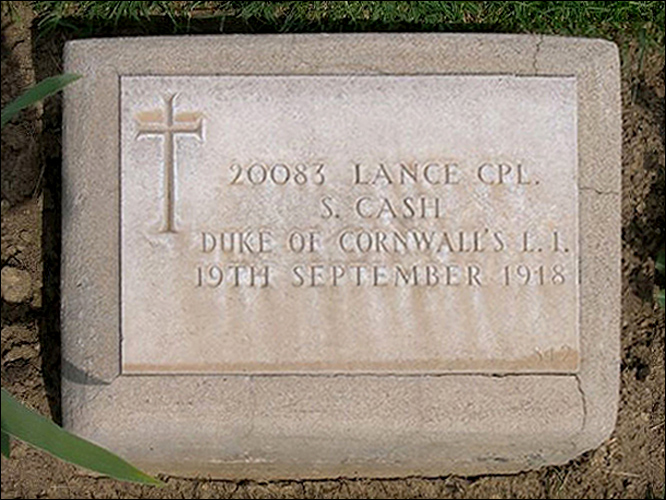
Died of Wounds Salonika on Thursday, 19th September 1918, age 26.
Buried in Grave D. 842. at Karasouli Military Cemetery, Greece.
2nd Bn., Duke of Cornwall's Light Infantry. 82nd Brigade of 27th Division.
Formerly 9304 Royal Warwickshire Regiment.
Son of Walter Cash, of Great Bridge; husband of Elizabeth Cash, of 7 Lewis Street, Great Bridge, Tipton, Staffs.
Born: West Bromwich, Enlisted: Birmingham, Resident: Tipton.
First landed France & Flanders, 6th May 1915.
Medal entitlement: 1914-15 Star, British War Medal, Victory Medal.
Soldier's Papers at National Archives did not survive.
Commemorated on the Tipton Library, and St. Peter's, Greets Green memorials.
Commemorated here because he appears on a Tipton memorial.
Link to Commonwealth War Graves Site: www.cwgc.org/find-war-dead/casualty/622997/
Genealogical Data
Birth of Samuel Cash registered March quarter 1892 in Dudley. Mother's maiden name was Rushton.
1901 Census
283 Whitehall Road, West Bromwich, Staffs.
Walter Cash (35, Widower, Under Hand Axle Roller, born West Bromwich), and his 5 children: John James (12, born West Bromwich), Lucy (11, born West Bromwich), Samuel (9, born West Bromwich), Lydia (6, born West Bromwich), and Sarah (4, born West Bromwich).
1911 Census
16 Farley Street, West Bromwich, Staffs.
Walter Cash (44, Coal Wheeler, born West Bromwich), his second wife of 4 years Eliza (46, born West Bromwich), and Walter's son : Samuel (19, Tube Screwer, born West Bromwich), plus his 5 step-sons: Denis Bratt (18, Bricklayer's Labourer, born West Bromwich), George Bratt (16, Straightener at Tube Works, born West Bromwich), Richard Bratt (14, Errand Boy, born West Bromwich), Elizah Bratt (11, School, born West Bromwich), and Benjamin Bratt (7, School, born West Bromwich).
Marriage of Samuel Cash and Elizabeth White conducted at St. Martin's Church, Tipton on 19th November 1911. Samuel and Elizabeth had 2 children: Alfred born 27th April 1912 and Lily May born 23rd May 1913.
Personal Data
After Samuel's death, his outstanding army pay and allowances amounted to £15/3/4d (15 pounds, 3 shillings and 4 pence); this was paid to his widow and sole legatee, Elizabeth, in January 1919. His War Gratuity was £18/0/0d (18 pounds exactly), this was also paid to Elizabeth in December 1919. The value of the War Gratuity suggests that Samuel had enlisted in approximately December 1914.
Samuel's widow, Elizabeth, was granted a one-off pension grant of £7/0/0d on 8th October 1918. She also received a Widow's Pension of £1/5/5d (1 pound, 5 shillings and 5 pence) per week for herself and her 2 children, effective from 7th April 1919. Her address at that time was 7 Lewis Street, Great Bridge, Tipton. Eliabeth married David Cornfield in September quarter 1923; the widow's element of her pension would cease and she would have been compensated by Re-marriage Gratuity about the value of a year's worth of pension. The pension allowance in respect of her 2 children would continue until their 16th birthdays.
In 1911, David Cornfield had been a Gunner in the Royal Garrison Artillery, stationed in India; it appears that he remained ther for the duration of the war as he is recorded as "Mountain Battery (India)", probably in the North-West frontier, in today's Pakistan.
Action resulting in his death
Samuel Cash first landed in France on May 6th 1915, and would have moved to Salonika in November 1915. British troops arrived in Salonika from October 1915, intended to deter Bulgaria from joining Germany and Austria-Hungary in attacking Serbia. Salonika was regarded by the British as a 'side show' as Britain had no political, commercial or strategic interests in the region apart from seeing the First World War to a favourable conclusion.
Conditions in Salonika were appalling, in November 1915 they faced blizzards and dense fog. There was a lack of roads so the state of the ground meant terrain was impassable in parts with army vehicles sinking into the mud. When summer arrived in 1916, they were faced with soaring temperatures. In Salonika, for every casualty in battle, three died of malaria, influenza or other diseases.
In preparation for the 3rd Battle of Doiran, bombardment of the Bulgarian lines began on the 15th September 1917, and on the same day the 2nd Battalion Duke of Cornwall’s Light Infantry (2/DCLI) raided the Tranche des Loups (Wolf Trench). However, the Bulgarians had already retreated and the raid concluded with no casualties.
The 3rd Battle of Doiran took place on the 18th - 19th September 1918. British involvement was to attack the heights west and north-east of Lake Doiran. The 2/DCLI was on the left flank, west of the river Vardar. To be precise, they were in the “Roche Noir” sector with their line extending from Yatagan to Hill 153. This was a line of old Bulgar trenches captured by the Gloucesters on September 1st.
The main focus of the attack was further to the east, closer to Lake Dorian. The War Diary of the 2/DCLI makes no mention that the offensive had begun. Regardless, 3 men of 2/DCLI were killed in action that day, and Samuel Cash died of wounds on the next day.
Samuel is buried in Karasouli Military Cemetery; Karasouli is today called Polykastro. This is about 7 miles south of the site the 2/DCLI action on September 18th, the day that Samuel is likely to have been wounded.
Newspaper Cuttings
Birmingham Daily Post 8th January 1917
RANK AND FILE: MIDLANDS MEN.
The following casualties amongst warrant officers, non-commissioned officers, and men are reported under various dates:
WOUNDED.
Duke of Cornwall's L.I.- Cash, 20083, S., (Tipton).